
The Mediterranean Diet IS a Diabetic Diet!

Over the years there have been a number of different strategies for diabetic diets. For a long time diabetics were taught to use exchange lists. That method worked well but was cumbersome for a lot of folks. More recently the training has focused on counting carbohydrates at each meal or snack. For diabetics who take insulin being careful with regulating when and what they eat is key and counting carbs works well for them.

The majority of diabetics, however, have Type 2 diabetes and don’t take insulin. For these folks simply following a healthy diet is the best choice.

Multiple studies show that diet can have as powerful an effect on controlling cholesterol as medications. We know that a Mediterranean style diet can help folks lose weight, prevent high blood pressure and avoid diabetes. But, can it also treat diabetes? A study published in the Annals of Internal Medicine says yes (Ann Intern Med. 2009;151:306-314). A resounding yes!

Researchers in Naples, Italy randomized 215 Type 2 diabetics to either a low fat diet similar to the one recommended by the American Diabetic Association or a Mediterranean style diet providing about 50% of calories from carbohydrates and 30% from fat. These were patients who had Hemoglobin A1c levels less than 11% (this is a measure of diabetic control with good control being under 7%).

The Mediterranean diet is rich in vegetables and whole grains, low in red meat, and higher in poultry and fish. Calories were restricted to 1500 per day for women and 1800 per day for men. The diet had 30% or more calories from fat, with the main source of added fat as olive oil. The low-fat diet was based on American Heart Association guidelines, being rich in whole grains with a restriction of additional fats, sweets, and high-fat snacks. Calories were the same as for the Mediterranean diet, with the target of less than 30% of calories from fat.

The study looked at the number of participants who needed to be put on medication for their diabetes. The researchers set the goal of having a Hemoglobin A1c over 7% for more than 3 months as the criteria for starting medication. The results are pretty amazing. Those following the Mediterranean style diet avoided medication 56% of the time while 70% of those following the low fat American Heart Association style diet ended up taking meds. Those on the Mediterranean style diet also lost more weight and had a greater improvement in their cholesterol and blood pressures.


Reading Food Labels

With all this the information on a food package it helps if you know how to use the Nutrition Facts box.

A good example is a 16 ounce bottle of juice. You think it’s a healthy choice. It seems reasonable to drink the whole bottle, but it’s actually a lot of calories. A quick glance at the Nutrition Facts shows that there are only 120 calories per serving, but if you don’t look closely you might not notice that there are two servings in the bottle, adding up to 240 calories in the whole bottle.

Thinking of the Nutrition Facts as separate sections makes it easier to use. These are highlighted in colors but they are not color coded on packages. The first section (in gray) shows you the serving size and the number of servings in the package. As with the orange juice example, it’s easy to get tripped up here because often smaller packages are really single servings but manufacturers will list them as 2 or 3 servings.

x
x
x
x
x

Always start by looking at the serving size and the number of servings in the package.

The next (white) section shows the number of calories per serving. Simple enough, but again, it’s important to look at the number of servings per container. This section also tells you how many of those calories are from fat. In this case it’s pretty high – almost half of the calories are from fat.

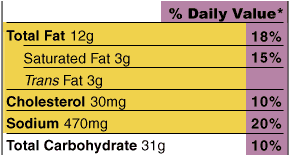
Section three is the most important. The yellow part shows you the amount of fat, cholesterol and sodium there is in each serving. There is also a breakdown of the fats by type: Saturated and Trans Fats. Note that this food contains Trans Fat and put it back on the shelf. You want a food or ingredient with zero (0) Trans Fats.

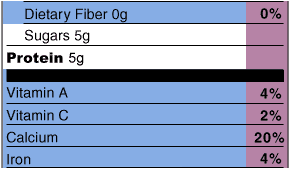
The white part of this section has similar information on carbohydrate and protein. In this section, focus on the amount of sugars. While a lot of foods are high in natural sugars – fruit, juices and the like – it’s a good idea to limit the amount of sugar.

The blue section shows similar information on the amount of fiber (the more the better) as well as information on vitamins and minerals.

The section highlighted in purple should be used as a guide for quick and easy information. It shows the “Percent Daily Value” for fat, cholesterol, sodium, etc. that you should have in a day. In this example the food has 18% of the total fat you should have for the day (these percentages are based on a 2,000 calorie diet).

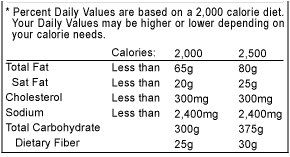
The bottom section is a guide as to those recommended amounts. Unfortunately, not a lot of folks should be eating 2,000 or more calories per day, so you have to make adjustments based on your needs.

A quick way to evaluate a food is the 20 / 5 rule. When you look at a package, if the fat, sodium or cholesterol are under 5%, that’s good. If any are over 20% you should consider carefully. For total carbohydrates, dietary fiber, vitamins and minerals, a DV of 5% or lower is bad; a DV of 20% or higher is good. This rule works great when you are looking at recipes in magazines or cookbooks that list nutrition information.

Here’s a table to help:

Less than 5% More than 20%
Fat Good Bad
Sodium Good Bad
Cholesterol Good Bad
Carbohydrates Bad Good
Fiber Bad Good
Vitamins A & C Bad Good
Calcium, Iron Bad Good

Keep in mind that some foods will be naturally high in one macronutrient or another. Butter is not bad for you even though it is almost all fat. Choosing your foods and ingredients is about balance. More on this later.

Take a minute and grab a few cans and boxes from your pantry. Look at them using this guide to test yourself, and you’ll be ready any time you go to the grocery store.

Breakfast Guidelines

Weekday Breakfast Option No. 1

Cereal with Milk (or Yogurt) and a piece of Fruit

Cereals should have about 100 – 150 calories in a serving.

1/2 cup of milk is great. Using a half cup of non-fat yogurt is even better.

Cereal Choices

Cereal Amount per serving Comment
Whole Grain Cheerios 1 cup (30 grams) Multi-grain is best!
Kellogg’s All-Bran Extra Fiber 1 cup
Kellogg’s All-Bran Original 1 cup
Bear Naked Fruit and Nut 1/3 cup Great with plain yogurt and fruit
Bite Size Shredded Wheat 1 cup (52 grams) Not frosted
Raisin Bran 1 cup
Total Whole Grain 1 cup
Total Raisin Bran 1 cup
Kashi Cinnamon Crisp 1 cup
Kashi Go Original 1 cup (53 grams)
Oatmeal 1/4 cup (before cooking)
Cream of Wheat 1/4 cup (before cooking)

Cereal and granola bars are not a great choice for breakfast. Eating a granola bar is not a good substitute for a real breakfast. Many of them have a lot of added calories without the amount of fiber that you would want (usually as sugar).

Weekday Breakfast Option No. 2

Breads and Protein and a piece of Fruit

Breads should be served with a protein. Select one from the bread choices, one topping for your bread, and one choice from the protein list.

Making muffins or quickbreads from the recipes on the Web site on Saturday or Sunday is a great way to have a quick, delicious breakfast on hand throughout the week. It’s healthier and you’ll save a lot of money.

Bread Choices

Breads Amount Comment
Slice of Whole Wheat Toast One Choose whole grain breads. The more fiber the better.
Bagel 1/2 large bagel Choose a whole wheat bagel
Whole wheat English Muffin 1 whole muffin
Muffin or Quickbread One Here are some muffin and quickbread recipes
Whole Grain Frozen Waffle One Kellogg’s Nutri-grain are OK, Lifestream Gluten Free are better, Kashi is fair.

Toppings and Spreads for Breads

Spreads (Choose one) Amount Comment
Butter 1 tsp.
Preserves or Jam 2 tsp. Look for “low-sugar”
Reduced-fat Cream Cheese 2 tsp. The “light” cream cheese is best for spreading.

Protein Choices

Protein Amount Comment
1 Large Egg One Cook in as little fat as possible.
Peanut Butter 2 Tablespoons Use instead of other spreads and choose a brand with as few added ingredients as possible (Smuckers Natural, for example)
Cheese 1 ounce
Milk 1/2 cup
Yogurt 1 cup Choose yogurt with no added sugar

Weekend Breakfast Options

On weekends you can eat the same breakfast as you do during the week, or try one of the breakfast recipes here on the website.

Nut and Seed Choices

We know now that nuts and seeds are really good for you. So much research has now shown that they’re a great choice in everything from snacks to being used as part of recipes. One important study shows that nuts added to a Mediterranean Diet made a huge difference in developing metabolic syndrome (Arch Intern Med 2008: 168; 2449 – 2458). Do keep in mind that nuts are considered fats and are higher in calories. Even so, the types of fat are so much better for you since most are low in saturated fat and high in unsaturated fats.

In another study of folks already on a Mediterranean diet, those who added walnuts to their diet had an additional 4% decrease in total cholesterol. Eating 3 ounces of almonds per day for 9 weeks had a as much as a 10% drop in cholesterol. To make it even better nuts and seeds are chock full of antioxidants and Vitamin E as well as magnesium, copper, monounsaturated fat, plant sterols, protein and fiber.

While a lot of the studies are funded by industry groups like the California Walnut Commission, much of it is excellent research and the conclusions are pretty compelling. Eat what you like. Raw may be better than roasted and certainly eating your nuts unsalted is likely to be better for you.

One important thing for those with diverticulosis. It may be that you have been told to avoid eating nuts and seeds in the past to prevent a flare-up of diverticulitis. Thank goodness this has now been disproven. In fact, those who ate more than two servings of nuts a week had about the same or slightly lower risk of problems than those who ate less than one serving per month. (This includes popcorn, corn and the tiny seeds from strawberries and blueberries.)

But… if you like dry roasted salted peanuts, I’m fine with that. You’re definitely better off eating salted nuts than eating Doritos or Wheat Thins. The nuts have a few more calories in an ounce (170 for the nuts and 140 for the Doritos) but they have about half the salt (85 mg for the nuts and 180 mg for the Doritos).

Peanut butter is a fantastic choice in your diet and the fresh ground that you can purchase in some stores. If you purchase peanut butter in jars, look for the ones with the fewest ingredients.

Keep at least some of the following on hand:

  • Almonds (whole, slivered and sliced)
  • Pecans
  • Walnuts
  • Sesame seeds (white and black)
  • Poppy seeds
  • Sunflower seeds
  • peanuts
  • Pinenuts
  • Pumpkin seeds

If you can, buy the nuts at the health food store where you can purchase them raw and get only a handful or so at a time so that they don’t go bad (they’ll last about 2 months sealed in plastic).

Don’t be afraid of nuts. Make seeds your friends. You’ll be healthier for sure.


Grapefruit Interactions

There are well known interactions with certain medications and grapefruit and scientists have identified the exact substance in grapefruit that causes the problem. We now know that furanocoumarins (naturally-occurring substances found in grapefruit’s juice) are the culprit.

The issue is how those furanocoumarins interact with the CYP3A4 enzyme made in the liver. The problem arises because of the way this enzyme acts on certain medications. Drinking grapefruit juice affects this enzyme and interferes with how they are broken down. We don’t know exactly how long after eating grapefruit or drinking the juice the effect wears off, however. Consequently the ongoing presence of the grapefruit in the body continues to have an effect on the system.

Interestingly, there are also CYP3A4 enzyme produced in the intestine that can interfere with the availability of drugs being absorbed into the bloodstream. As a result you should be aware that there may not be a safe time to take some medications when eating grapefruit or drinking grapefruit juice.

One of the questions is just which drugs can be a problem. Part of the confusion comes from the fact that some are well documented in good research and others are only suspected at this time because the CYP3A4 enzyme is used for processing the medication in our bodies.

Known or possible interactions with grapefruit juice:

Albendazole (Albenza)
Alfentanil (Alfenta)
Alfuzosin (Uroxatral)
Almotriptan (Axert)
Alprazolam (Xanax)
Amiodarone (Cordarone)
Amlodipine (Norvasc)
Aprepitant (Emend)
Aripiprazole (Abilify)
Artemether (Riamet, Co-Artem)
Atorvastatin (Lipitor)
Bupropion (Wellbutrin, Zyban)
Buspirone (BuSpar)
Carbamazepine (Tegretol)
Carvedilol (Coreg)
Cilostazol (Pletal)
Cinacalcet (Sensipar)
Clarithromycin (Biaxin)
Clomipramine (Anafranil)
Codeine
Colchicine 5
Cyclosporine (Neoral)
Dapsone
Darifenacin (Enablex)
Delavirdine (Rescriptor)
Dextromethorphan
Diazepam (Valium)
Diltiazem (Cardizem, Tiazac)
Dofetilide (Tikosyn)
Efavirenz (Sustiva)
Eletriptan (Relpax)
Erlotinib (Tarceva)
Erythromycin (Eryc, E-mycin, Erythromid, Erybid)
Estrogens
Eszopiclone (Lunesta)
Etoposide (Vepesid)
Felodipine (Plendil)
Fentanyl (Sublimaze)
Fexofenadine (Allegra)
Fuvoxamine (Luvox)
Finasteride (Propecia, Proscar)
Gefitinib (Iressa)
Halofantrine (Halfan)
Haloperidol (Haldol)
Imatinib mesylate (Gleevec/Glivec)
Indinavir (Crixivan)
Itraconazole (Sporanox)
Losartan (Cozaar)
Lovastatin (Mevacor)
Methadone (Dolophine)
Methylprednisolone (Medrol)
Midazolam (Versed)
Mifepristone (Mifeprex)
Montelukast (Singulair)
Nelfinavir (Viracept)
Nicardipine (Cardene)
Nifedipine (Procardia)
Nimodipine (Nimotop)
Nisoldipine (Sular)
Ondansetron (Zofran)
Oxybutynin (Ditropan)
Paclitaxel (Taxol)
Pimozide (Orap)
Progestins
Propafenone (Rythmol)
Quetiapine fumarate (Seroquel)
Quinidine (Quinaglute, quinine, Quinidex)
Ramelteon (Rozerem)
Ritonavir (Norvir)
Saquinavir (Invirase)
Sertraline (Zoloft)
Sildenafil (Viagra)
Simvastatin (Zocor)
Sirolimus (Rapamune)
Solifenacin (Vesicare)
Tacrolimus (Prograf)
Tamoxifen (Nolvadex)
Tamsulosin (Flomax)
Tolterodine (Detrol)
Trazodone (Desyrel)
Triazolam (Halcion)
Vincristine (Oncovin)
Warfarin (Coumadin)
Zaleplon (Zonata)
Ziprasidone (Geodon)
Zolpidem (Ambien)

Last updated: 09/15/08

Diverticulitis, nuts and seeds.

We receive a lot of questions to the Ask feature of the website about diverticulosis. Here are some examples:

“Is eating strawberries a no-no for persons with Diverticulitis?  I note that you say that the seeds in cucumbers and tomatoes are really not a problem.”

Will you please give me some information on how to eat for diverticulitis – do I really have to ‘seed’ a can of tomatoes? Can I still be a spontaneous cook?

People with diverticulosis have small out-pouchings of the colon. It is a very common condition with 1/3 of the population developing diverticulosis by the age of 60 and 2/3 by the time they reach 85. Oftentimes the pouches will become infected and the result can be quite serious with abscess formation, hospitalization and frequently surgery. The longstanding theory has been that the seeds might become stuck in the small diverticula (pouches) and create a setting for infection (known as diverticulitis).

In the past there has been some controversy about the treatment of this problem with many doctors telling their patients with diverticulosis to not eat popcorn, seeds, nuts or foods that contain seeds, such as those found in tomatoes, cucumbers and strawberries. In the past there was never any solid research to support this, however. In the last few years good studies have disproved that a problem exists.

The theory seems a bit silly but almost certainly so with strawberry seeds (those things are tiny!). Guidelines no longer make this recommendation. The studies have shown that the only dietary change that will make a difference for those with diverticulosis is a high fiber diet (and of course, a high fiber diet is the recommendation for all of us).

One of the largest studies on this subject was published just last week. Researchers looked at more than 47,000 men over 18 years as part of the Health Professionals Follow-up Study. The most fascinating finding was that those men who ate the most nuts and popcorn actually had lower risk of infection. In short, no association was found between an increased risk of diverticulitis and eating nuts, popcorn or corn. (JAMA. 2008;300(8):907-914)

The clear answer from the research right now indicates that you don’t need to worry. Eat tomatoes and do be a spontaneous cook again!


How Much Should You Weigh? (cont.)

The table below shows the range of weights for a normal Body Mass Index. Research shows that a healthier weight should fall between the weights for a BMI of 19 to 25.  BMI is not a perfect indicator, however, and should be used as a guide.

For instance, if you are 63 inches tall (5 foot 3 inches), a good range for a healthy weight is between 107 lbs. and 141 lbs. Look at the table below to see if your weight falls within the normal range – or use the BMI calculator in the left-hand column of this page.

Normal Weight Body Mass Index

BMI 19 20 21 22 23 24 25
Height
(inches)
Body Weight (pounds)
58 91 96 100 105 110 115 119
59 94 99 104 109 114 119 124
60 97 102 107 112 118 123 128
61 100 106 111 116 122 127 132
62 104 109 115 120 126 131 136
63 107 113 118 124 130 135 141
64 110 116 122 128 134 140 145
65 114 120 126 132 138 144 150
66 118 124 130 136 142 148 155
67 121 127 134 140 146 153 159
68 125 131 138 144 151 158 164
69 128 135 142 149 155 162 169
70 132 139 146 153 160 167 174
71 136 143 150 157 165 172 179
72 140 147 154 162 169 177 184
73 144 151 159 166 174 182 189
74 148 155 163 171 179 186 194
75 152 160 168 176 184 192 200
76 156 164 172 180 189 197 205

This table shows the World Health Organization’s definition of what range of Body Mass Index means in terms of weight.

Body Mass Index Clinical Definition of:
Less than 18.5 underweight
18.5 to 24.9 normal weight
25 to 29.9 overweight
30 or more obese
greater than 35 very obese

While BMI information is not perfect, it is a pretty good guide for the majority of the population. (Who are the exceptions?)

Possibly an even more important measure of your weight with respect to your health is the Waist to Hip Ratio »

More About Fiber

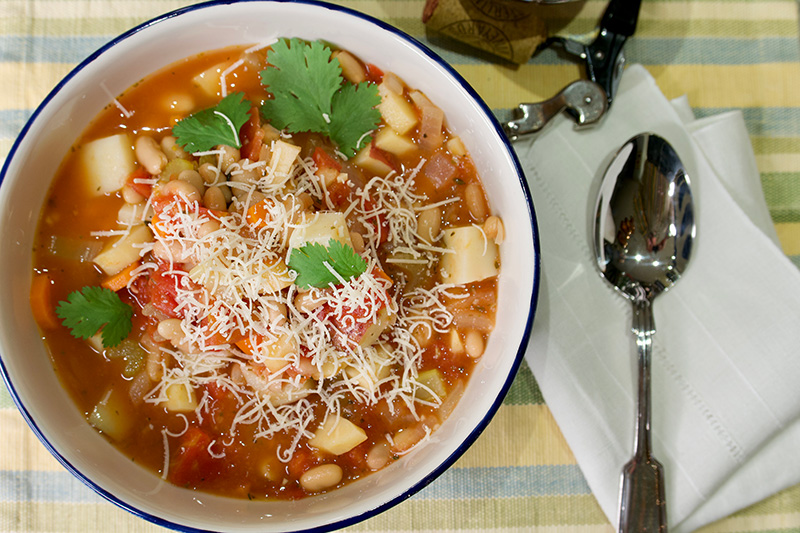
Minestrone is high in fiber - click for recipe!

There’s no doubt that this is one key to eating healthier and being more satisfied when you do eat. Pay attention to this in every recipe that you cook and every ingredient you choose.

For some folks this might take some getting used to. If you’ve been eating white bread all your life, you may have to try the lighter version of whole wheat bread before you transition to high fiber breads. It’s worth it though. Study after study is showing how important this is to living longer and living better.

Here’s a handy guide of ingredients for you to use that can help boost the fiber in your diet. Slowly replace the ingredients that you have on hand with the higher fiber alternative.

Instead of… Have some…
White Bread Whole Wheat Bread
English Muffin Whole Wheat English Muffin
Bagel Whole Wheat Bagel
White Rice Brown Rice
White Rice Wild Rice
White Rice Lentils
Regular Pasta Whole Wheat Pasta
Corn Beans or Lentils
Potatoes Sweet Potatoes
Potatoes Yams
Corn Flakes Bran Flakes
Special K Cheerios
Fruit Loops Life Cereal
Rice Krispies Kashi GoLean Crunch
Apple Jacks Kashi Cinnamon Harvest
Grits Oatmeal
Apple Juice Apples
Orange Juice Oranges
Grapefruit Juice Grapefruit

In addition, when you’re looking for snacks take a look at the Nutrition Facts and make sure that you’re choosing one with as much fiber as possible. A snack with 3 grams of fiber per serving or more is best.

Below is a list of recipes on the website that have ten grams of fiber or more. This is a good way to begin to work more fiber choices into your diet.

Maple Glazed Salmon with Lentils 17g
Pizza with Roasted Eggplant and Feta 18g
Minestrone 18g
Napa Cabbage Salad with Seared Tuna 19g
Lentil and Bulgur Soup 21g
Ratatouille 16g
Lemon Pork with Lentils 15g
Sea Bass with White Beans and Tomato Vinaigrette 14g
One Skillet Chicken and Black Beans 14g
Chopped Salad with Wild Rice 13g
Pork Chops with Warm Tomatillo Salsa 13g
Split Pea Soup 13g
White Chili 12g
Eggplant Parmesan 11g
Chile Con Carne 11g
Chinese Chicken Salad 11g
French Onion Soup 11g
Barbecue Chicken Pizza 11g
Fettuccine with Roasted Eggplant and Broccoli 11g
Fettuccine with Roasted Red Pepper Vinaigrette 11g
Pizza with Dill Pesto and Potato 11g
Fish and Root Vegetable Stew 11g
Taco Salad 10g
Pizza with Mushrooms and Prosciutto 10g
Roasted Tomato and Garlic Pizza 10g
Blue Cheese Crab and Fusilli Pasta 10g
Fish Enchiladas 10g


Cooking with Alcohol

A lot of recipes use wine or other alcoholic beverages as important ingredients. Many people don’t wish to use any alcohol, however, and fortunately there are many alternatives now.

With the cooking process, most of the alcohol evaporates, but never completely. Quite simply, it depends on how long you cook a particular recipe. Keep in mind that there’s less than a half-teaspoon of alcohol in a tablespoon of wine. Alcohol evaporates faster than the water in the wine, but there will still be a little alcohol left after cooking.

The amount that remains depends on what is being cooked, as noted in the table below. A stew, such as beef bourguignon, that cooks for a few hours will have time for more of the alcohol to burn off. On the other hand, a dish that is rapidly cooked, such as chicken piccata, may have as much as 50% of the alcohol remaining. So you could be getting as much as 1/4 teaspoon of alcohol in a serving of chicken piccata made with white wine. The same serving of the beef bourguignon will have about the same 1/4 teaspoon of alcohol, even though the recipe begins with 2 cups of wine.

Scientists at the USDA measured the alcohol content of foods prepared by different methods. This table shows the results of those experiments.

Preparation Method

% of Alcohol Retained

Alcohol added to boiling liquid & removed from heat 85%
Flamed (as with a flambé) 75%
No heat and stored overnight 70%
Baked for 25 minutes with the alcohol not stirred into mixture 45%
Baked or simmered with the alcohol stirred into mixture depends on the amount of time:
15 minutes 40%
30 minutes 35%
1 hour 25%
1 1/2 hours 20%
2 hours 10%
2 1/2 hours 5%

There are some very good non-alcoholic wines on the market — some made by the better California vineyards.

To replace rum or bourbon, you can use extracts that have similar flavors. Extracts are concentrated liquids that flavor recipes but have little flavor of their own. They are made in a number of ways. Some flavors require distillation as with bourbon or vanilla extract and these are usually suspended in a small amount of alcohol. As a rule of thumb, factor about 1/2 teaspoon of extract in 2 tablespoons of water per serving in a dish such as the Pork Chops with Bourbon Pecan Sauce.

For a lot of people even the 25% contained in an extract is more than they wish to use but in that 1/2 tsp. there’s only 1/8 tsp. of alcohol. In a dish such as this, about 40% will burn off, leaving just over 1/16 of a teaspoon.

Eating Out

Going out to eat is so easy these days, and it’s so much a part of our lives that most of us don’t think much about it. This is, however, key to to eating healthy. Because you’re not in control of how the food is made and what goes in it, it’s hard to know exactly what you’re eating. For a lot of folks this is where so many extra calories come from.

Here are ten pretty simple rules that can help you make it easier to eat well, eat healthy and enjoy life.

No. 1 – Go out to eat, but when you go out, enjoy it.
Don’t just eat out because there’s no time to cook. Eating great food takes a bit of advance planning and being “trapped” into not cooking for yourself is the easiest way to end up eating food that’s not so great tasting and not great for you.

When you do go, pick a restaurant before you go that you know will have great food.

No 2. – Stop going out so much.
Eating out is so easy now. However, the key to being healthy is to begin making your own food and cooking from fresh ingredients.

This takes a little planning but there’s so many great resources available. While there’s plenty of recipes on the Web site there are also hundreds of thousands of great healthy meals to be found on the Internet and most of them take less than 30 minutes to cook.

That’s less time than it takes to drive to most restaurants or even order in a calorie-dense but nutritionally empty pizza that tastes like the cardboard box it was delivered in.

No. 3 – Don’t eat fast food.
Just don’t. Just stop going to McDonald’s, Burger King, Wendy’s and any place like them. If the restaurant you go to doesn’t make food fresh, don’t go there.

In spite of what McDonald’s would have you think, they and the fast food chains like them are responsible for the obesity epidemic. There’s not much of anything on their menus that’s very good for you. Most everything that is available is pre-made in a factory somewhere and not a lot different than what you find in a frozen TV dinner.

The research is clear that it’s just as cheap now to make your own food. Not only is the meal less expensive, there’s great evidence that you’ll pay less in doctor’s bills later.

No. 4 – If you do have to eat fast food, check out the lists on the Web site first.
There’s a lot of info that will help you make better choice. These files can be downloaded as PDF documents so you can print them out and take them with you to the restaurant.

No. 5 – Don’t go out to eat without a plan.
This is not much different from how to eat better in general. One of the easiest places to get tripped up is not thinking about where or what we’re going to eat. If you have a plan, then it’s more likely that you won’t be needing to go out anyway.

No. 6 – If the menu says a dish is “fried,” don’t order it.
This a simple rule and one that you should live by for all of your healthy eating. There’s rarely any fried food that’s all that great tasting except for the occasional fried chicken. That said, you should never order fried chicken that’s not fantastic. If it’s not chicken that makes you come close to crying because it’s so good, don’t eat it.

No. 7 – Order something different.
Look at the whole menu. Choose something new. Have something that you’ve never had before (follow Rule No. 6, Rule No. 8 and Rule No. 9). The best way to experience new food is to let someone else cook for you.

No. 8 – Sauce on the side.
This is true for main dishes, but it’s especially true for salad dressings. A lot of salad dressings are really high in calories and if you have only a couple of tablespoons, instead of 1/3 cup of dressing, you’ll save as much as 150 calories on your otherwise healthy salad.

No. 9 – Order seafood.
This is an easy one because a lot of people don’t like to cook fish. People often are not confident in how to cook seafood and getting your seafood when you eat out is a great idea. By having fish you’re having what is likely the healthiest thing on the menu. At the same time you’ll find which fish you really love, and from there it’s easy to find a recipe you’ll love on the Web site or among the thousands of other sites on the internet.

Eat healthy fish in a restaurant, cook it at home, easy.

No. 10 – Eat half.
For those of you who are working on losing some weight or if you encounter a dish that’s huge, simply eat half. There’s a lot of advantage in this. Not only do you get a great dinner you’ll get a great lunch or dinner the next day.

Asking the waiter or waitress for a take home box when your meal arrives. Divvy it up and put the take home half away. Clean your plate and you’re good to go.