

Soy and Your Risk of Breast Cancer
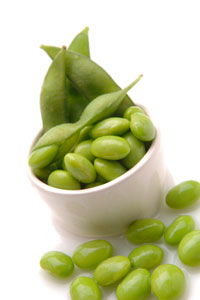
Many cancer docs tell those women with estrogen-receptor positive breast cancer to avoid eating soybeans. Why? Because they contain a comparatively high level of isoflavones (phytoestrogens), which are naturally occurring chemicals that resemble natural estrogen. Soybeans (edamame) are a major source of protein in the Asian diet, and at least one study has reported that Chinese women who eat a lot of soy actually have a reduced risk of breast cancer. Which is right?
 Researchers at the University of Southern California and the University of Minnesota recently looked at 28 studies of soy intake and its effects on breast cancer risk (Brit J Cancer 2008; 98(1):9-14). Six of those studies had focused on people in Asia, while the other 22 took place in Western countries. Those women in the studies who ate a traditional Asian diet averaged eating 25 to 50 milligrams of isoflavones per day, because soy is such a major source of protein in their diet.
People who follow a more traditional Western-style diet—like those in the United States and the United Kingdom—get most of their protein from animal sources. A Westerner's typical daily intake of isoflavones is under 1 milligram per day.
Finally the scientists compared the breast cancer rates of who ate the most isoflavones (over 20 milligrams of isoflavones per day) to those who ate the least (5 milligrams or less of isoflavones per day). Those women eating the highest levels of isoflavones reduced their risk of breast cancer by almost 30% over those who ate the least! Meanwhile, those women who consumed what they termed a “moderate amount” of isoflavones (between 5 and 10 milligrams of isoflavones per day) saw their risk of breast cancer reduced by about 12%.
Compared to an Asian-style diet, a Western-style diet had a far smaller typical intake of isoflavones of less than 1 milligram per day. The average intake was about half a milligram. Most of the studies of Western-style diets that the scientists reviewed showed no meaningful change in risk between the smallest level of soy intake (about 0.15 milligrams of isoflavones per day) and the largest (about 0.8 milligrams of isoflavones per day).
What this means for you
Most Westerners would have to change their diets and eat A LOT of soy to make a significant difference in their risk of breast cancer. You’d have to eat easily at least 20 times what you get now. Unless your oncologist says you should do otherwise, it's unlikely that eating soy (or not eating it) will have an effect on your risk of breast cancer.
First posted: August 27, 2008
 Print
Print